We have been distributing the CATS system in Spain and advising installers before, during, and after installation. Most of the problems we encounter are not due to equipment failures. They are installation errors that could have been avoided with the right information before starting.
Some become apparent as soon as the job is finished. Others don’t show up until weeks or months later, when the system is already up and running and the installer has moved on to another project. This article covers the most common issues: what causes them, what their consequences are, and how to prevent them.
How to Tell If an Installation Has a Problem
Before discussing specific errors, here are the symptoms that, in our experience, indicate that something did not run correctly:
- The system is performing below design specifications for no apparent reason related to the boiler or the pump.
- There is noise or audible turbulence in a section of the pipe.
- A microleak appears at or near a bend or a fitting.
- The pressure at a certain point in the circuit does not reach the expected value.
If you recognize any of these symptoms, the cause is almost always one of the errors described below. In most cases, the problematic section can be identified and replaced without having to redo the entire installation.
Summary Table: Errors, Consequences, and Solutions
| Error | Consequence | Solution |
| Using a copper bender | Damaged waves that aren’t visible | Always fold by hand |
| Bend near the fitting | Warranty of Leak-Tightness for the Joint | Leave at least 2 pipe diameters of straight pipe before bending |
| Two curves with no straight section in between | Stress, premature fatigue | Leave at least 10 cm of straight section between curves |
| Confusing DN with outer diameter | Underestimated minimum radius, constriction | Always use the actual outer diameter listed on the technical data sheet |
| Do not check this section after folding | Undetected constriction, loss of flow | Systematic visual inspection after every turn |
| Insufficient or rigid fastening | Damage Caused by Thermal Expansion Over Long Cycles | Use supports with clearance that allow for axial movement |
| Cut with a generic tool | Deformed end piece, leak in the fitting | Using the CATS 250 Pipe Cutter |
The Eight Mistakes in Detail
Mistake 1: Using a copper bender
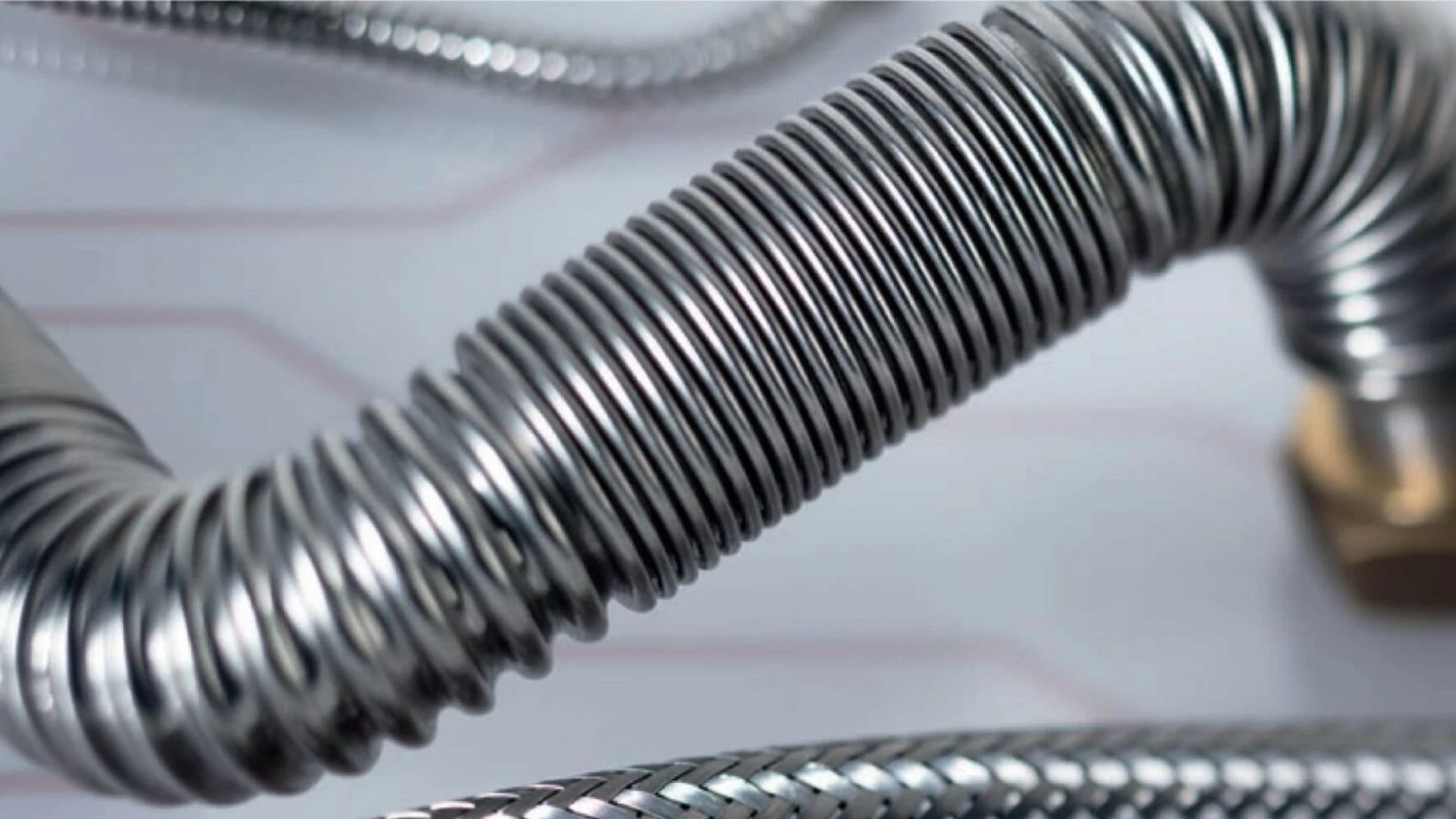
This is the most common issue among installers who have previously worked with copper. Copper benders apply force to smooth surfaces and flatten the corrugations of the corrugated tube at the point of contact. The result looks correct visually but has deformed corrugations on the inner surface that compromise the cross-section and create points of concentrated stress.
CATS tubing is bent by hand, without the use of bending tools. That is precisely one of its advantages: you don’t need any special equipment. The minimum certified radius is between 1.20 and 1.70 times the tube’s outer diameter.
Mistake 2: Bending too close to a fitting
When space is limited, it is tempting to bend the pipe practically from the end of the fitting. The problem is not the bend itself, but rather the transmission of force: part of the bending stress is transferred to the joint and can displace the sealing seat or deform the metal-to-metal contact area.
The installation may pass the initial pressure test but develop a microleak weeks later. Always leave at least two pipe diameters of straight pipe between the end of the fitting and the start of the bend.
Error 3: Two consecutive curves with no straight section in between
Continuously bending the tube from one angle to the next concentrates the stress in a very short section. The corrugations in the intermediate section act simultaneously in two directions and can exceed their elastic limit even if neither of the two bends individually exceeds the minimum radius.
Always leave at least 10 cm of straight path between two consecutive changes in direction. In practice, there is almost always enough space if you plan your route before turning.
Mistake 4: Confusing the DN with the actual outer diameter
The DN is a reference value for classification, not the actual outer diameter of the pipe. If you calculate the minimum radius based on the DN instead of the actual outer diameter, you’ll have less margin than you think. The actual outer diameter for each CATS system model is listed in the product data sheet.
Mistake 5: Not checking the section after folding
A visual inspection after bending takes less than ten seconds and prevents most problems that are detected too late. At the point of maximum curvature, the corrugations on the outer surface should be slightly separated, and those on the inner surface should be slightly compressed, without collapsing. If any corrugation has given way or the section has lost its circular shape, it must be cut and redone.
A bend with a restricted cross-section can operate for months with a loss of flow that no one attributes to that point until someone measures the system’s performance.
Error 6: Insufficient or completely rigid fixation
This issue is particularly relevant in air-source heat pump and solar thermal systems, where the pipe is subjected to wide and repeated temperature fluctuations. Stainless steel has a coefficient of thermal expansion of approximately 16 mm per 10 meters of pipe for every 10°C change in temperature. In a solar system with cycles ranging from 20°C to 120°C, this axial movement is a real factor and must be allowed to occur.
If the pipe is secured with completely rigid clamps with no play, thermal expansion causes accumulated internal stresses. If it is secured at very few points or without sufficient support, it can move in an uncontrolled manner and transfer that stress to the fittings.
The correct solution is to use supports that allow for axial movement of the pipe, especially in long runs and in installations subject to significant thermal cycling. In practice, this means using clamps with a slight amount of play or sliding supports on long straight runs, and fixed anchor points only where strictly necessary.
Mistake 7: Cutting the pipe with a generic tool
A standard cutter can deform the last few corrugations at the end of the tube, leaving it slightly elliptical at the cut end. This deformation makes it difficult to seat the fitting properly and can compromise the seal from the very beginning.
The CATS 250 pipe cutter has four wheels that stabilize the pipe during cutting and ensure a clean, perpendicular cut. Consistent use of this tool eliminates one of the most common causes of leaks during initial startup.
Most problems don’t stem from the material
In all the years we have been distributing the CATS system, material failures have been the exception. DVGW-certified AISI 316L does not fail under normal installation conditions. What fails is the installation itself: a bend that’s too tight, a fitting with accumulated stress, or a section without vibration damping.
The good news is that all the errors described here can be avoided without complicating the work. The CATS system is designed precisely to ensure quick and reliable installation. When something goes wrong, there is almost always a specific technical cause that can be identified and corrected.
If you have any questions before getting started, or if you’re dealing with an installation that’s exhibiting symptoms you can’t explain, the technical team at AZ Broquetas is available to help you identify the cause.
Frequently Asked Questions
The clearest sign is a collapsed ripple on the inner surface or a section that has lost its circular shape. If everything looks fine visually but the system is performing below design specifications, there may be a partial constriction that is not visible to the naked eye. Inspecting the curved area with a flashlight is usually sufficient to identify it.
No. A collapsed corrugation does not return to its original position. The section must be cut and redone. With the CATS system, this can be done quickly on-site without special tools.
In aerothermal systems, temperature cycles are frequent, with differences of up to 50–60°C between startup and operating temperature. A 10-meter section of pipe can expand by between 8 and 10 mm within that range. If the supports do not allow for this movement, stress builds up at the fittings and can cause leaks over time.
Installation errors are not covered by the product warranty, which covers manufacturing defects. AZ Broquetas offers pre-installation technical support to help prevent them from occurring. Please contact us before you begin if you have any questions.
Luis Broquetas is the director of AZ Broquetas, the exclusive distributor in Spain for AZ Intec, a German manufacturer specializing in corrugated stainless steel tubing (CSST) systems for residential, commercial, and industrial installations. Certifications: DVGW, ISO 9001, ISO 14001.